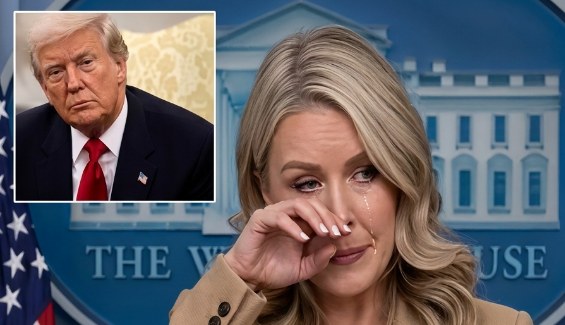
WASHINGTON — White House Press Secretary Karoline Leavitt defended the Trump administration’s approach to presidential press access during a discussion with Axios co-founder Mike Allen, arguing that changes to longstanding media procedures are intended to broaden participation rather than restrict journalism.
Leavitt’s comments came amid an ongoing dispute over how the White House
selects journalists for limited-access events and the role of the White House Correspondents’ Association in determining press-pool membership.
Speaking at an Axios event in Washington, Leavitt rejected the characterization that the administration’s changes amounted to restrictions on the press.
“I don’t view them as restrictions,” Leavitt said, arguing instead that the White House was seeking to open access to “more outlets, more voices, more news, journalists and outlets.”
Leavitt Questions Traditional Press-Pool System
One of the central issues discussed was the presidential press pool, a small group of journalists who receive access to events where space is limited, including certain Oval Office appearances and presidential travel.
Leavitt questioned why one news organization should retain a permanent place in the 13-member pool.
“Why should a single outlet have the privilege of being in that 13-person press pool every single day?” she asked.
Under the administration’s revised approach, the White House press office took a greater role in determining which outlets participate in the pool. Axios reported in February 2025 that the change represented a departure from decades of practice in which the White House Correspondents’ Association handled the rotation.
Leavitt argued that the change could provide opportunities for organizations that historically had less access to presidential events.
The administration has also expanded participation by independent journalists, podcasters, social-media personalities and other digital-media figures. When Leavitt began her tenure as press secretary in January 2025, she announced that two seats in the briefing room would be opened to what she described as “new media voices.”
AP Dispute Adds to Tensions
The discussion took place against the backdrop of a separate dispute involving the Associated Press.
The White House restricted AP access to certain presidential events after the news organization declined to adopt the administration’s preferred terminology, “Gulf of America,” for the body of water traditionally known as the Gulf of Mexico.
The AP challenged the restrictions in federal court, arguing that the administration’s actions violated its First Amendment rights. U.S. District Judge Trevor McFadden ordered the administration to treat the AP in the same manner as other news organizations, according to AP’s account of the litigation.
The dispute also highlighted a broader question over whether the government should determine which independent news organizations receive access when space is limited.
The White House has argued that access to presidential events is not itself a constitutional right and that the administration should have authority to determine which journalists participate in limited-space settings. The White House Correspondents’ Association has opposed the administration’s expanded role in selecting the press pool.
Changing Media Landscape
Leavitt connected the administration’s approach to broader changes in the news industry.
Traditional newspapers, television networks and wire services now compete with online publications, podcasts, independent reporters and social-media creators for audiences. Leavitt said the White House should reflect that changing media environment when determining which journalists receive access.
“It’s not about ideology,” she said. “It’s about increasing the wide array of outlets that have access.”
The argument has supporters and critics.
Supporters of the administration’s policy say established news organizations should not automatically receive preferred access simply because they have historically occupied those positions. Critics counter that government officials should not be given broad authority to decide which independent journalists are permitted to cover them.
The disagreement therefore extends beyond individual reporters or news organizations and raises questions about the appropriate boundary between government control over its facilities and the independence of the press.
Trump and Biden Media Comparisons
The Axios discussion also touched on the differing media strategies of President Trump and former President Joe Biden.
An Axios analysis published in July 2024, based on data compiled by presidential scholar Martha Joynt Kumar, found that Biden had participated in 164 formal press conferences and interviews by June 30 of his fourth year in office. Trump had participated in 468 at the comparable point, while Barack Obama had 570. The analysis also included figures for other recent presidents.
Axios noted that the figures measured formal press conferences and interviews and did not capture every interaction between a president and journalists. Biden also conducted informal question-and-answer sessions with smaller groups of reporters, meaning the numbers do not represent every instance in which he engaged with the press.
The comparison illustrates how presidential communication strategies can differ substantially even when administrations face similar demands for transparency and accountability.
Debate Likely to Continue
The dispute over press access is unlikely to disappear as the White House continues experimenting with its media strategy.
The administration says expanding the pool to newer and nontraditional outlets creates a broader media environment. Traditional news organizations and press advocates have raised questions about whether giving the government greater control over limited-access assignments could affect the independence of presidential coverage.
Both sides agree that the media landscape has changed. The continuing disagreement is over how that change should affect access to the presidency.
For journalists, the challenge remains balancing the practical value of access with the need for independent reporting. For the White House, the issue involves determining how presidential events should be covered while responding to a media environment that is increasingly diverse and fragmented.
The debate over Leavitt’s press policies therefore reflects a larger question facing modern American journalism: how should access to the most powerful office in the country be distributed in an era when the definition of a news organization is changing rapidly?