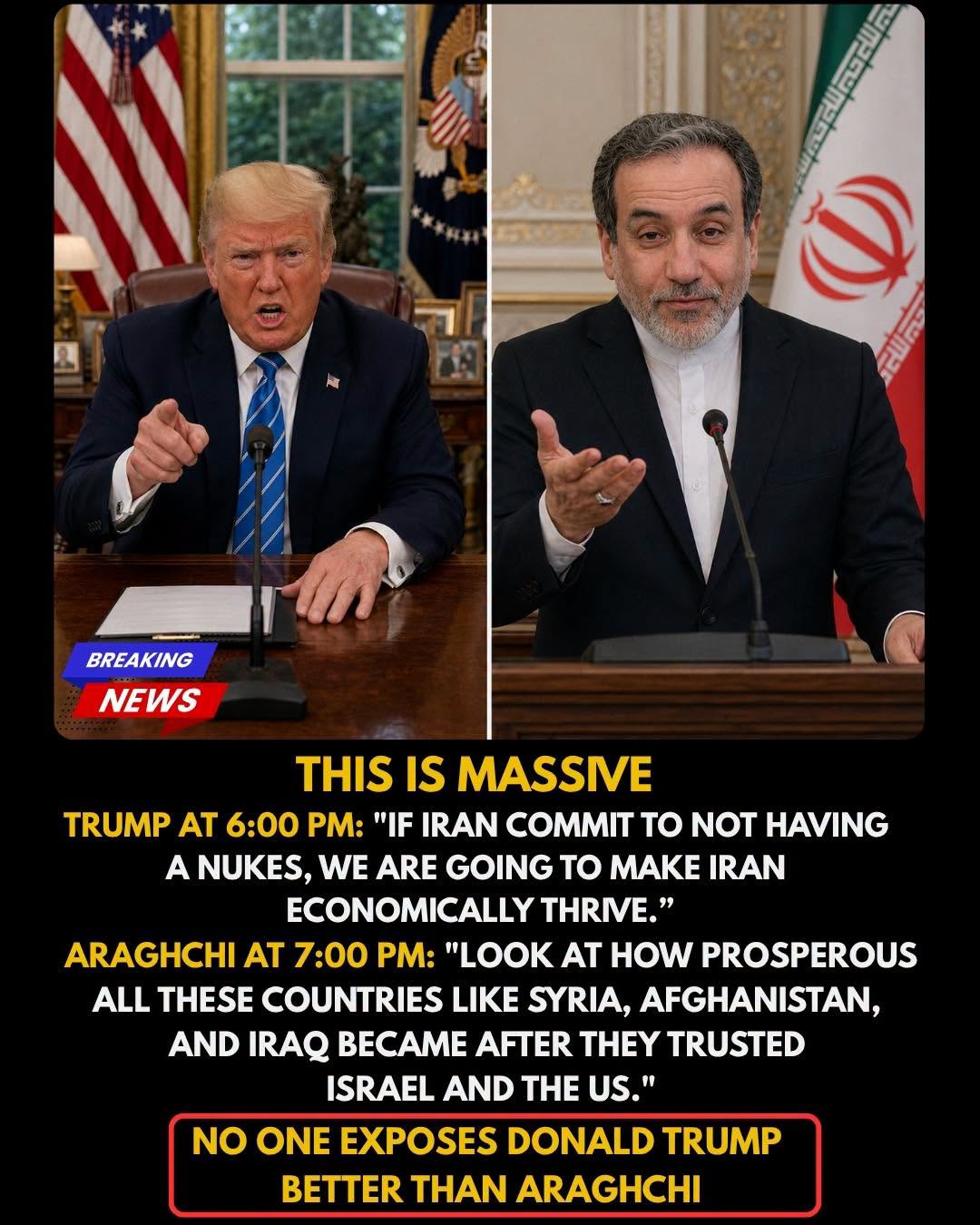

This exchange didn’t just challenge Trump’s promise—it turned it into a brutal history lesson.
Donald Trump reportedly said that if Iran commits to never developing nuclear weapons, the United States will help the country prosper economically. The message sounds simple: abandon nuclear ambitions, reach an agreement with Washington, gain sanctions relief, and unlock a more prosperous future.
Trump has repeatedly insisted that Iran must never possess a nuclear weapon, while presenting economic pressure and military force as tools for pushing Tehran toward an agreement. Iran, meanwhile, maintains that its nuclear activities are peaceful and argues that negotiations cannot succeed while threats and sanctions continue.
Then came the response circulating online and attributed to Iranian Foreign Minister Abbas Araghchi:
“Look at how prosperous countries like Syria, Afghanistan, and Iraq became after trusting Israel and the United States.”
That reply cuts directly into Washington’s credibility problem. Iraq suffered years of war and instability after the 2003 U.S.-led invasion. Afghanistan endured two decades of American military involvement before the chaotic 2021 withdrawal. Syria remains devastated after civil war, foreign intervention, sanctions, displacement, and regional power struggles.
Araghchi’s alleged message is essentially this: why should Iran trust promises of prosperity from governments associated with destruction and instability across the region?
Of course, those countries have complicated histories, and their suffering cannot be blamed on one foreign power alone. But the sarcasm works because it attacks the gap between America’s promises and the consequences many people in the Middle East remember.
Trump offered Iran a vision of wealth in exchange for compliance. Araghchi’s attributed response pointed toward the ruins left behind by previous interventions.
No one exposes Donald Trump’s sales pitch quite like Araghchi.